How to Outsource SEO: Complete Guide for Businesses and Agencies
Zenith Ranking Editorial · Oct 31, 2026
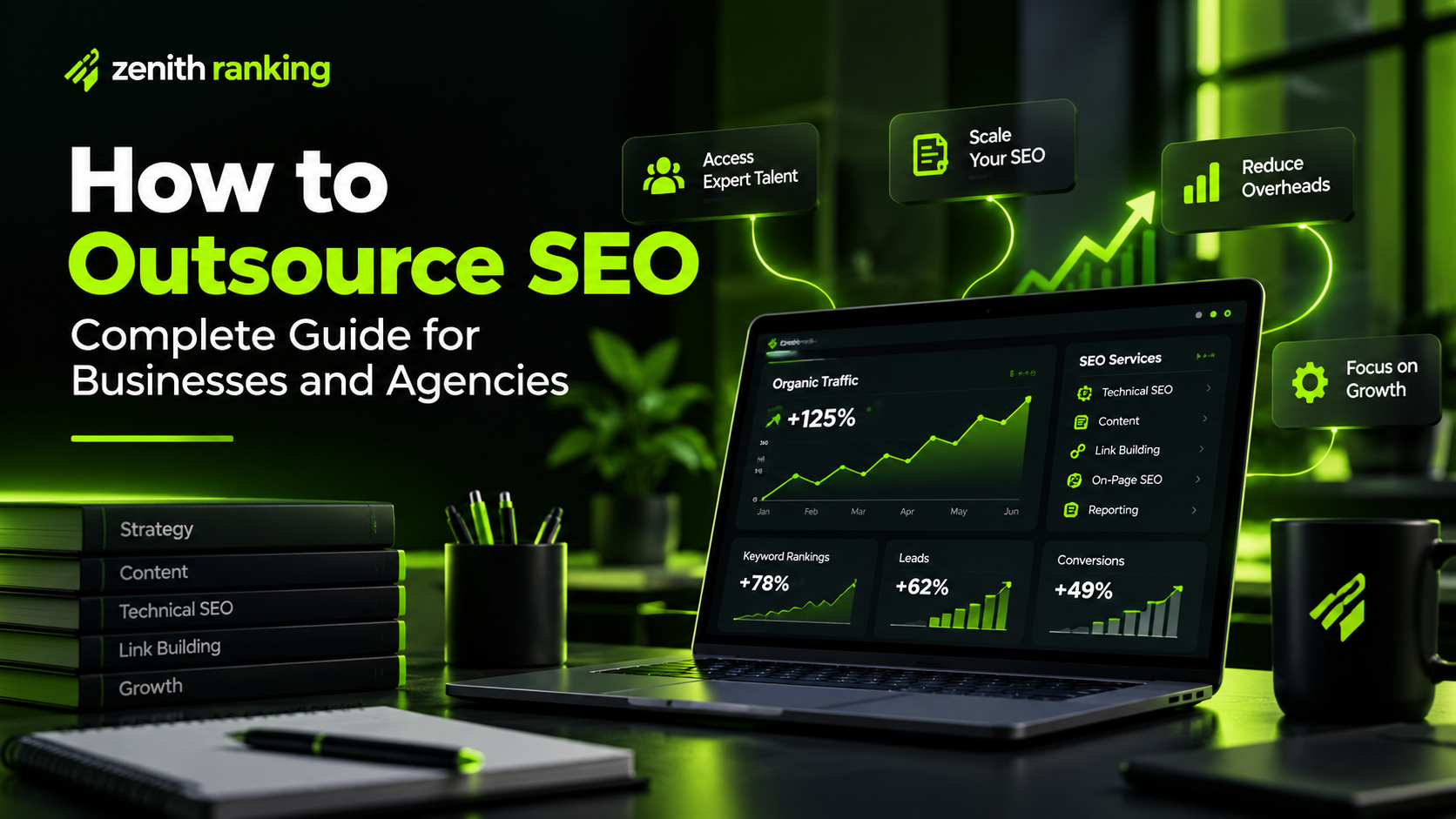
Businesses and marketing agencies often outsource SEO to access specialist expertise, improve search visibility, and scale their marketing efforts without hiring an entire in-house team. However, successful SEO outsourcing requires more than choosing a provider. It involves selecting the right services, setting clear expectations, and ensuring every investment supports measurable business growth.But outsourcing doesn't automatically improve rankings or reduce costs.
A company might hire an external SEO provider and receive monthly reports, content and backlinks, yet see little meaningful progress because the work doesn't address its actual growth opportunities.
Successful SEO outsourcing starts with identifying what needs improving, choosing the right delivery model and establishing clear accountability for results.
This guide explains what to outsource, how to compare providers, what affects costs and how businesses and agencies can maintain quality.
What Does It Mean to Outsource SEO?
SEO outsourcing means hiring an external specialist, freelancer or agency to manage some or all of your search engine optimisation activities.
These activities can include technical SEO, keyword research, content strategy, on-page optimisation, link building and performance reporting.
For example, an e-commerce business might outsource technical SEO and content optimisation while keeping product information and brand decisions internally.
Similarly, a digital marketing agency could outsource specialist SEO delivery while maintaining its direct relationship with clients.
The purpose is not necessarily to replace an internal team. Outsourcing can provide expertise, capacity or specialist support where it is most needed.
When Should a Business Outsource SEO?
Outsourcing makes the most sense when there is a clear gap between the SEO work required and the resources available to deliver it.
1. Your website isn't generating enough qualified traffic
A business may publish content regularly but struggle to improve rankings or conversions.
An external SEO specialist can help identify whether the problem relates to search intent, technical accessibility, content quality, competition or website authority.
For example, an online retailer ranking between positions 15 and 30 for commercially relevant keywords may benefit more from improving existing category pages than publishing additional general blog posts.
The right solution depends on the diagnosis.
2. You need specialist expertise
SEO covers several disciplines that require different capabilities.
A content specialist may be excellent at keyword research and editorial planning but lack the technical experience to diagnose JavaScript rendering or complex canonicalisation issues.
Outsourcing can provide access to those specialist skills without requiring a permanent hire for every discipline.
3. Your agency needs more delivery capacity
For marketing agencies, outsourcing can be a way to increase capacity while maintaining an established client relationship.
Consider an agency managing five SEO clients that wins another three accounts.
Hiring immediately may introduce fixed costs before the additional revenue becomes predictable.
An external delivery partner can provide additional capacity, provided responsibilities, quality standards and timelines are clearly agreed.
Which SEO Services Can You Outsource?
Not every business needs a fully outsourced SEO programme.
The right scope depends on existing capabilities, budget and growth priorities.
| SEO serviceWhat an external provider can deliverBest suited for | ||
| Technical SEO | Crawl audits, indexing analysis, technical recommendations | Websites with technical or structural issues |
| Keyword research | Keyword mapping, search intent and competitor analysis | Businesses planning new content or landing pages |
| On-page SEO | Metadata, headings, content optimisation and internal linking | Websites with existing ranking opportunities |
| SEO content | Content briefs, articles, landing pages and optimisation | Teams lacking editorial capacity |
| Link building | Relevant link opportunities, placement assessment and reporting | Businesses needing external authority development |
| SEO reporting | Search visibility, traffic and conversion analysis | Teams needing structured performance measurement |
A common mistake is outsourcing the most visible activity rather than the most important one.
For example, acquiring backlinks may not be the best immediate investment if important landing pages are blocked from indexing.
The work should follow the website's priorities, not a standard package that treats every business identically.
How to Outsource SEO Successfully: 5 Key Decisions
1. Define the business outcome
Before selecting an SEO provider, establish what success should look like.
For an e-commerce company, the objective might be increasing organic revenue from product categories.
For a B2B business, it could be generating more qualified enquiries through commercial landing pages.
For an agency, success may mean delivering agreed SEO work across additional client accounts without reducing quality.
These objectives should influence the scope, budget and reporting requirements.
2. Choose the right outsourcing model
Three common outsourcing arrangements serve different needs.
| ModelMain advantageMain limitation | ||
| SEO freelancer | Flexible specialist support | Capacity and skill coverage may be limited |
| SEO agency | Broader services and coordinated delivery | Requires a larger budget and clear accountability |
| Specialist delivery partner | Additional execution capacity for agencies | Requires effective handoffs and quality control |
A freelancer may be appropriate for a defined technical audit. A full-service agency may be better suited to managing a broader SEO programme.
An agency handling multiple clients may prefer a delivery partner that can support repeatable services.
3. Evaluate the provider's expertise
A strong SEO provider should be able to explain what work is needed, why it matters and how progress will be assessed.
Google's official guidance on hiring an SEO recommends reviewing experience, previous work, expected results, communication and compliance with search guidelines.
Before choosing a provider, evaluate:
- Relevant experience: Have they worked with comparable websites or industries?
- Technical understanding: Can they explain issues beyond surface-level audit scores?
- Content quality: Is the proposed work aligned with search intent and user needs?
- Transparency: Are deliverables, responsibilities and reporting clearly defined?
- Realistic expectations: Do they avoid guaranteeing specific rankings?
A provider promising a number-one Google ranking should be treated with caution.
4. Agree on deliverables and responsibilities
SEO outsourcing arrangements can become ineffective when expectations are vague.
For example, a package described as "monthly SEO optimisation" doesn't explain which pages will be improved, who will implement technical changes or how work will be approved.
A better agreement defines the actual deliverables.
Illustrative monthly SEO scope:
| DeliverableExample scope | |
| Technical SEO | Audit priority templates and review identified issues |
| On-page optimisation | Improve 5 priority landing pages |
| Content | Produce 4 researched content briefs |
| Internal linking | Review links across relevant topic clusters |
| Reporting | Monthly performance review and next-step recommendations |
These quantities are examples, not standard industry requirements or a description of Zenith Ranking's packages.
The scope should also clarify whether implementation, revisions and publishing are included.
5. Measure outcomes, not just activity
Publishing ten articles or completing twenty optimisations doesn't necessarily mean SEO performance has improved.
Performance should be evaluated against the business objective.
For example, an agency might complete all agreed monthly tasks while its client's most important commercial pages continue losing visibility.
A useful review should connect completed work with changes in search impressions, qualified traffic, conversions and technical health.
SEO results take time, so short-term fluctuations should not automatically be treated as success or failure.
How Much Does It Cost to Outsource SEO?
SEO outsourcing costs vary based on the website's size, competition, service requirements, geographic market and provider expertise.
A small local business requiring basic optimisation will usually have a different scope from an international e-commerce website with thousands of URLs.
Rather than relying on one headline price, businesses should compare the services and resources included.
Example: Comparing outsourcing with an internal hire
Consider a hypothetical agency deciding how to provide 80 hours of SEO delivery each month.
| Cost componentIn-house specialistOutsourced delivery | ||
| Monthly staffing or service cost | £3,200 | £2,800 |
| Additional tools and overhead | £400 | Included |
| Total monthly cost | £3,600 | £2,800 |
| Annual equivalent | £43,200 | £33,600 |
Illustrative scenario only; these are not verified market averages or Zenith Ranking prices.
In this example, outsourcing costs £9,600 less annually.
However, the comparison is only meaningful if both arrangements provide equivalent capacity, quality and scope.
An in-house employee may also contribute to meetings, strategic planning and other responsibilities that are not included in an outsourced delivery package.
For a more accurate comparison, calculate the cost per accepted deliverable and account for internal management time.
Outsourced SEO vs. In-House SEO: Which Is Better?
Neither approach is universally superior.
In-house SEO provides direct access to internal teams, product knowledge and business priorities.
Outsourcing can provide specialist expertise and adjustable delivery capacity without requiring a permanent hire for every function.
| FactorIn-house SEOOutsourced SEO | ||
| Business knowledge | Usually stronger initially | Requires onboarding |
| Specialist coverage | Depends on team size | Depends on provider capabilities |
| Fixed staffing costs | Higher commitment | Often more flexible |
| Direct control | Greater day-to-day control | Governed by agreed processes |
| Scalability | Requires hiring or reprioritisation | May allow capacity adjustments |
A hybrid model can also work well.
For example, a business may retain an internal marketing manager responsible for strategy and brand approvals while outsourcing technical audits, content production and link-building execution.
For agencies, the equivalent arrangement is retaining client management and strategic oversight while delegating clearly defined delivery tasks.
How to Maintain Quality When Outsourcing SEO
The biggest risk in outsourcing isn't necessarily losing direct control over every task. It's losing visibility into the quality of the work.
Three safeguards can reduce that risk.
Clear acceptance criteria
Every deliverable should have an agreed standard.
A content brief might require a defined search intent, relevant keyword coverage, accurate sources and internal linking recommendations.
A technical audit should explain the issue, affected URLs, business impact and recommended resolution.
Defined approval responsibilities
The business or agency should know who approves content, technical changes and publication.
External providers may recommend changes, but internal teams often need to validate brand claims, commercial priorities and implementation risks.
Transparent performance reporting
Reports should explain what was completed, what changed and what should happen next.
A report containing only keyword rankings and traffic charts may miss the reasoning behind the work.
For agencies, consistent reporting also helps maintain quality across multiple client accounts.
Common SEO Outsourcing Mistakes
Choosing the cheapest provider without evaluating scope
A lower monthly fee may exclude content revisions, technical implementation or important quality checks.
Compare deliverables rather than prices alone.
Outsourcing without clear priorities
When a provider receives only a general instruction to "improve SEO," work can become disconnected from business outcomes.
A defined objective and initial assessment create a better foundation.
Expecting guaranteed rankings
Google explicitly warns that no SEO provider can guarantee a number-one ranking.
Search results depend on numerous factors outside any provider's control.
Treating reports as proof of results
Completed tasks and attractive dashboards are useful, but they should not replace analysis of qualified traffic, search visibility and conversions.
Ignoring the quality of outsourced content and links
Poorly researched articles or manipulative link-building practices can create risks rather than improve performance.
Google's people-first content guidance emphasises original, reliable information created to benefit readers.
How Zenith Ranking Supports Outsourced SEO Delivery
Outsourcing works best when external expertise supports a clear business objective.
At Zenith Ranking, our approach to SEO focuses on connecting technical optimisation, content development, link building and performance measurement rather than treating them as disconnected activities.
For businesses, this means evaluating the website's search opportunities and identifying the work most relevant to organic growth.
For marketing agencies, outsourced SEO support can provide additional delivery capacity while allowing the agency to retain its client relationships and strategic oversight.
Whether the requirement is specialist execution or broader SEO support, the priority should be consistent quality, transparent deliverables and measurable progress.
Explore our SEO services to discuss the support your business or agency requires.
Frequently Asked Questions
Is outsourcing SEO worth it?
It can be worthwhile when a business needs specialist expertise or additional capacity that would be expensive or impractical to maintain internally. The value depends on service quality, scope and business outcomes.
What SEO tasks should you outsource first?
Start with the work creating the biggest constraint on performance. This could be technical SEO, content optimisation, keyword research or link building, depending on the website's current condition.
Can a small business outsource SEO?
Yes. Small businesses can outsource individual projects or ongoing SEO management. A clearly defined scope is particularly important when budgets are limited.
Is outsourcing SEO cheaper than hiring in-house?
It can be, especially when specialist support is needed without a full-time commitment. However, costs depend on the services included and the internal resources required to manage the relationship.
Can SEO agencies outsource client work?
Yes. Agencies can outsource defined SEO deliverables while maintaining client communication, strategy and quality oversight, subject to their client agreements.
How long does outsourced SEO take to show results?
There is no guaranteed timeline. Some technical improvements may be reflected relatively quickly, while competitive ranking and organic traffic improvements can take several months or longer.
Final Thoughts
SEO outsourcing should be treated as a strategic business decision, not simply a way to reduce marketing costs.
The right provider can offer expertise, additional capacity and more consistent execution. But those advantages depend on clear objectives, appropriate service selection and transparent accountability.
For businesses and agencies, the most effective approach is to outsource the work that supports growth while retaining visibility into quality, priorities and results.
Get a custom plan for your site.
Book a 20-minute strategy call. Free. No upsell.
Book a strategy call