What Is a Technical SEO Audit? A Beginner's Guide
Zenith Ranking Editorial · Nov 3, 2026
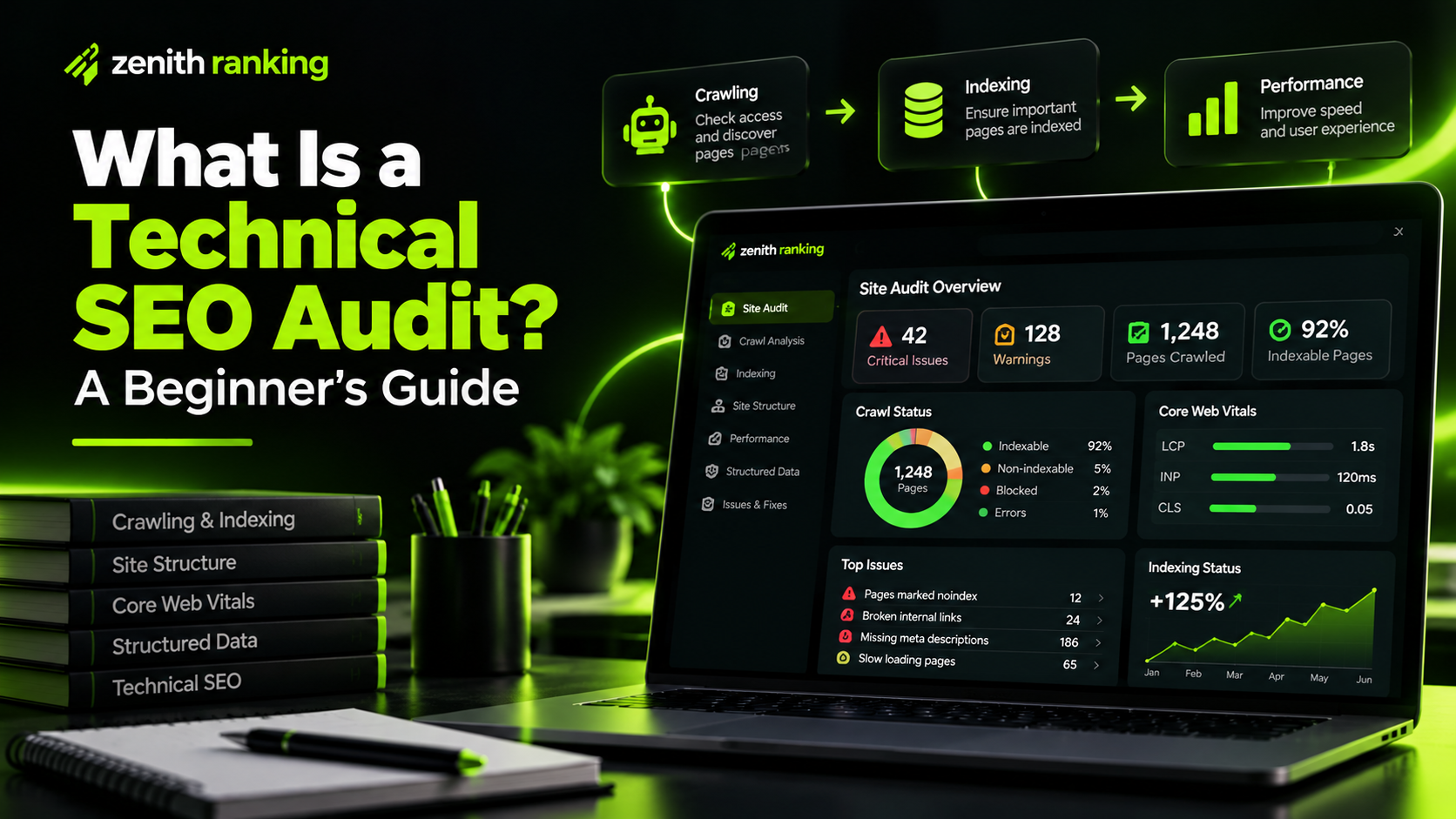
Your website might look perfectly fine to visitors while hiding problems that prevent important pages from appearing in Google. A service page could be accidentally excluded from indexing. Product pages might load slowly on mobile devices. Or a website redesign could leave valuable URLs pointing to the wrong destinations.
A technical SEO audit helps identify these problems before they continue affecting your website's search visibility.
But an audit is more than a list of errors generated by software. A useful technical SEO audit explains what is happening, why it matters, and which issues deserve attention first.
This beginner's guide covers what technical SEO audits involve, the problems they can uncover, and what businesses should expect from a professional assessment.
What Is a Technical SEO Audit?
A technical SEO audit is an assessment of the technical elements that affect how search engines discover, crawl, render, and index a website.
It examines whether search engines can access important pages, understand their content, and identify the correct URLs to display in search results.
Google describes Search as involving three main stages: crawling, indexing, and serving search results. Technical problems can interfere with the first two stages and influence how pages are presented in the third.
Source: Google Search Central — How Search Works.
For example, imagine a dental practice has published a page about emergency dental appointments.
The content is accurate, the page looks professional, and the business has included the relevant keywords. However, an accidental noindex directive tells search engines not to include the page in search results.
Improving the writing won't resolve that technical problem.
An audit helps identify the underlying issue so the appropriate correction can be made.
Why Is a Technical SEO Audit Important?
Technical SEO provides the foundation that allows other SEO activities to function effectively.
A business can invest in content, backlinks, and website design, but those investments may deliver limited organic visibility if important pages are inaccessible or incorrectly configured.
A technical SEO audit can help businesses:
- Identify pages that search engines cannot access or index.
- Detect broken URLs and redirect problems.
- Understand website speed and mobile performance issues.
- Find conflicting canonical and indexing signals.
- Assess whether internal links support page discovery.
- Identify technical problems introduced by website changes.
Importantly, not every technical warning represents a serious SEO problem.
For example, a page intentionally excluded from search results may be correctly configured. The same directive on a valuable service page could be a significant issue.
The value of an audit comes from distinguishing the two.
What Does a Technical SEO Audit Check?
A professional audit usually examines several connected areas of website health.
1. Crawling and indexing
Crawling is how search engines discover and access pages. Indexing involves processing page content for potential inclusion in search results.
An audit checks whether important URLs can be crawled and whether indexing directives match the website's intentions.
Common problems include accidental noindex tags, incorrect robots.txt rules, inaccessible pages, and important URLs missing from the site's internal linking structure.
Example: A business launches 30 new service-location pages, but the pages remain excluded from Google's index because a template contains an unintended noindex directive.
An audit can identify the shared configuration problem rather than treating all 30 URLs as separate issues.
Google's crawling and indexing documentation explains the technical signals involved.
2. Website structure and internal links
Website architecture determines how pages connect to one another.
A logical structure helps visitors navigate and gives search engines clearer paths to discover important content.
An audit reviews navigation, internal links, orphan pages, and the relationships between key sections.
For example, a software company may have an important product page that receives no internal links from relevant feature pages or articles.
The page might be technically accessible but poorly integrated into the website.
A professional assessment considers whether changes to internal linking would make the site easier to navigate and understand.
3. Canonical tags and duplicate URLs
Many websites generate multiple URLs containing identical or substantially similar content.
E-commerce filters, tracking parameters, and alternative URL formats can create these variations.
Canonical tags help indicate which URL should be treated as the preferred version.
Example:
A store has these URLs:
- /running-shoes/
- /running-shoes/?sort=price
- /running-shoes/?sort=popular
The website may intend the main category URL to be canonical, but inconsistent signals can make the preferred version unclear.
An audit checks whether canonical configurations support the intended website structure.
Google may select a different canonical URL from the one specified by the website, so the assessment should consider Google's interpretation rather than relying solely on the presence of a tag.
4. Website speed and Core Web Vitals
Slow-loading pages and unstable layouts can create a frustrating experience, particularly for mobile visitors.
Technical SEO audits commonly review Google's Core Web Vitals, which measure loading performance, responsiveness, and visual stability.
| MetricWhat it measuresGood threshold | ||
| Largest Contentful Paint (LCP) | Loading performance | 2.5 seconds or less |
| Interaction to Next Paint (INP) | Responsiveness | 200 milliseconds or less |
| Cumulative Layout Shift (CLS) | Visual stability | 0.1 or less |
Source: Google Search Central — Core Web Vitals.
Suppose a website's mobile pages have an LCP of 4.6 seconds.
The audit might identify oversized images, render-blocking resources, or slow server responses as potential contributors.
The objective isn't simply to improve a performance score. It's to identify the factors affecting the real user experience.
Good Core Web Vitals don't guarantee higher rankings, but they provide useful performance targets.
5. Broken links, redirects, and HTTP errors
Websites change over time. Pages are removed, URLs are updated, and content moves between sections.
Without appropriate handling, these changes can create broken internal links or unnecessary redirect chains.
For example, a company redesigns its website and changes a service page from /services/seo/ to /seo-services/.
If the original URL returns a 404 error despite the replacement being available, visitors and search engines following old links may not reach the new page.
An audit identifies affected URLs and assesses whether redirects, link updates, or other corrections are appropriate.
Not every 404 error requires fixing. A genuinely removed page with no suitable replacement may correctly return a 404 response.
6. Mobile rendering and JavaScript
Some websites rely heavily on JavaScript to display content, navigation, and interactive elements.
Although Google can render JavaScript, technical implementation problems can prevent important content or links from being processed as intended.
For example, a product page may display specifications correctly to visitors, but the content may be missing from the rendered HTML available to Google.
A technical SEO audit can investigate whether essential content and navigation are accessible to search engines.
Google explains this process in its JavaScript SEO guidance.
7. Structured data and search appearance
Structured data provides search engines with machine-readable information about certain types of page content.
Depending on the website, this may include product details, business information, articles, or other supported content types.
An audit checks whether relevant structured data is valid and accurately reflects the page.
For example, a product page may contain invalid Product markup that prevents eligibility for a supported rich-result appearance.
Structured data doesn't guarantee enhanced search results or improved rankings, but correct implementation can help search engines interpret eligible information.
What Does a Technical SEO Audit Report Look Like?
An audit report should explain findings in a way that business owners, marketers, and developers can understand.
Consider this hypothetical example from an e-commerce website:
| Finding | Affected URLs | Priority | Reason |
| Important product pages set to noindex | 12 | Critical | Prevents intended search visibility |
| Broken internal category links | 18 | High | Disrupts navigation and discovery |
| Poor mobile loading performance | 65 | High | Affects important page templates |
| Missing meta descriptions | 40 | Low | Less urgent than accessibility problems |
These figures are illustrative, not findings from a real Zenith Ranking audit.
The report shouldn't merely repeat what an automated tool discovered.
It should explain which issues are genuine, what causes them, which pages matter most, and what needs to happen next.
For a deeper explanation of interpreting findings and priority levels, read How to Read a Site Audit Report Like an Expert.
When Should You Get a Technical SEO Audit?
A technical SEO audit is particularly useful when a website experiences unexplained search performance problems or undergoes significant structural changes.
Common situations include a sudden decline in organic traffic, a website migration, a redesign, the launch of new page templates, or persistent indexing problems.
For example, if organic enquiries fall after a website redesign, the cause could involve changed URLs, redirects, internal links, or indexing settings.
A professional assessment helps determine whether technical issues contributed to the decline rather than assuming the problem is caused by an algorithm update.
Businesses operating larger or frequently changing websites may also benefit from ongoing technical monitoring between comprehensive audits.
Do You Need a Professional Technical SEO Audit?
Free tools can identify individual technical issues, but interpreting those findings requires context.
Google Search Console can show indexing and search performance information. PageSpeed Insights can highlight performance problems. Crawling software can identify technical patterns across many URLs.
However, these tools don't automatically determine which findings matter most to your business.
For example, 100 missing meta descriptions may be less urgent than one incorrectly configured service page responsible for a substantial share of qualified enquiries.
A professional technical SEO audit connects technical evidence with website priorities and provides a structured plan for improvement.
At Zenith Ranking, we focus on identifying meaningful technical barriers, understanding their potential impact, and helping businesses establish clear priorities.
If your website is experiencing indexing problems, declining visibility, or unexplained technical issues, you can request a full technical audit through our Site Audit Services.
Technical SEO Audit vs. Full SEO Site Audit
These two assessments are related, but they don't cover exactly the same scope.
| Technical SEO auditFull SEO site audit | |
| Crawling and indexing | Crawling and indexing |
| Canonical and redirect issues | Canonical and redirect issues |
| Mobile performance | Mobile performance |
| JavaScript and rendering | JavaScript and rendering |
| Technical site architecture | Technical and content architecture |
| Technical structured data checks | Content relevance and search intent |
| Technical recommendations | Broader SEO opportunities and priorities |
A technical audit concentrates on whether the website's technical foundation supports search visibility.
A full SEO site audit also examines content, keyword targeting, organic performance, and other factors that influence search growth.
For the broader process, see The Complete Guide to SEO Site Audits.
Frequently Asked Questions
What is the main purpose of a technical SEO audit?
The main purpose is to identify technical issues that may prevent search engines from discovering, accessing, understanding, or indexing important website content.
Is a technical SEO audit the same as an SEO audit?
No. A technical SEO audit focuses on technical website health, while a complete SEO audit also evaluates content relevance, keyword targeting, and broader organic performance.
How often should a website have a technical SEO audit?
It depends on the website's size, complexity, and frequency of changes. Significant redesigns, migrations, or unexplained indexing problems are good reasons to conduct an additional assessment.
Can a technical SEO audit improve rankings?
An audit identifies problems but doesn't directly improve rankings. Implementing appropriate recommendations may improve a website's search accessibility and performance, although ranking improvements aren't guaranteed.
Which tools are used for technical SEO audits?
Common tools include Google Search Console, Screaming Frog SEO Spider, Ahrefs Site Audit, PageSpeed Insights, and Google's Rich Results Test.
Final Thoughts
A technical SEO audit helps businesses understand whether their websites have the technical foundation needed to support organic search visibility.
It identifies issues involving crawling, indexing, website architecture, performance, and technical configuration.
But the real value comes from understanding which problems matter and how they affect important pages.
A good technical SEO audit doesn't simply tell you what's wrong. It helps you understand what deserves attention and why.
Get a custom plan for your site.
Book a 20-minute strategy call. Free. No upsell.
Book a strategy call