On-Page SEO: The Definitive Guide
Zenith Ranking Editorial · Nov 4, 2026
A website can publish useful content, target relevant keywords, and still struggle to attract organic traffic. Sometimes the problem isn't the topic itself. It's how the page presents information, matches search intent, and connects with the rest of the website.
On-page SEO helps address these problems by improving the content and elements of individual webpages so search engines can understand them and visitors can find what they need.
However, on-page SEO isn't simply about placing a keyword in the title, heading, and first paragraph. A page can satisfy every basic optimization checklist and still perform poorly if it doesn't answer the searcher's actual question.
This guide explains how on-page SEO works, which elements deserve attention, and how businesses can prioritize improvements that support search visibility and conversions.
What Is On-Page SEO?
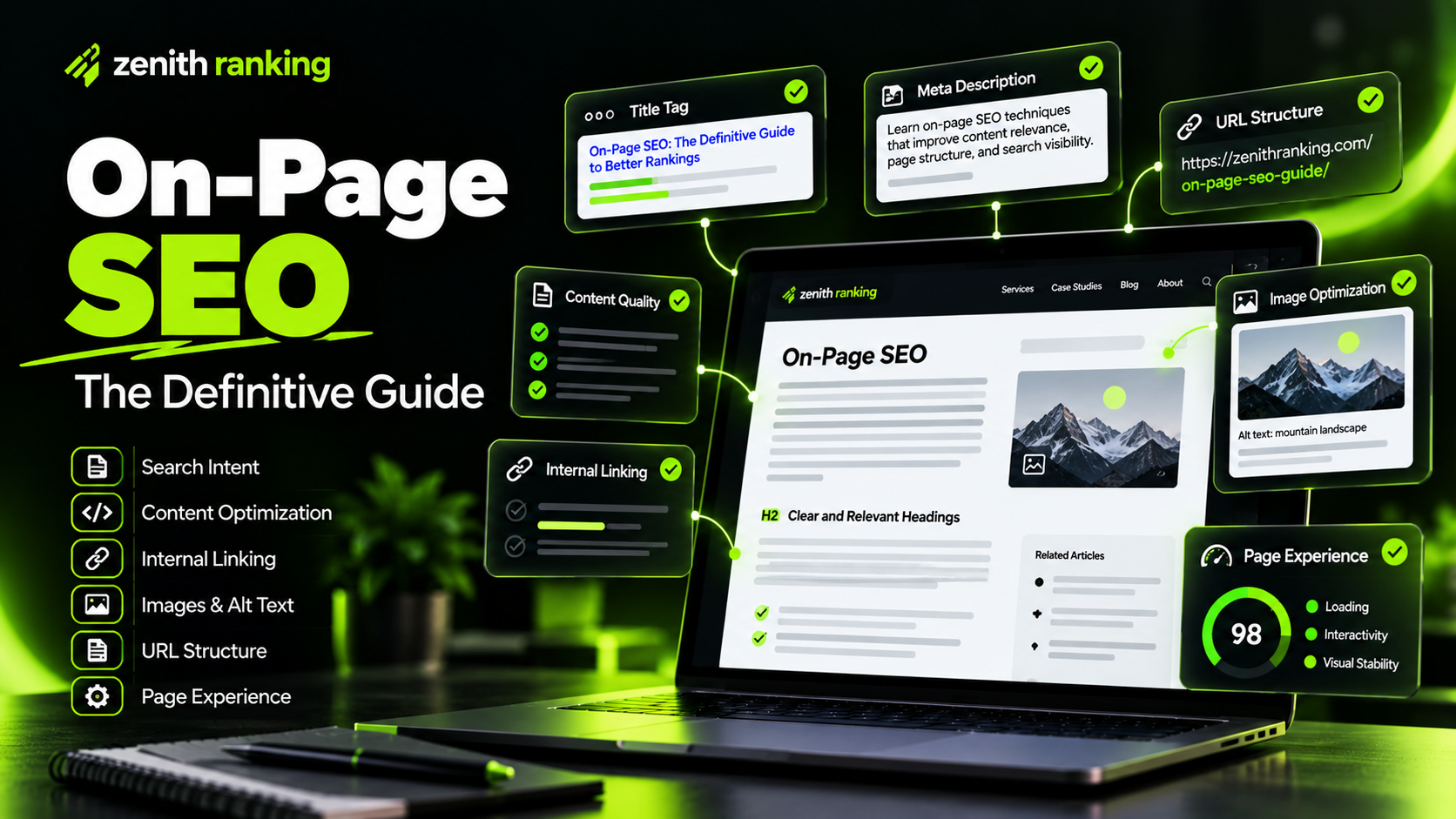
On-page SEO is the process of improving individual webpages to make their content, structure, and purpose clearer to search engines and users.
It includes optimizing:
- Page titles and meta descriptions.
- Headings and content structure.
- Search intent and topical relevance.
- Internal links and anchor text.
- Images and descriptive alt text.
- URLs and page usability.
- Content quality and freshness.
The objective is to make each page a useful, relevant result for the searches it targets.
For example, a business targeting the keyword accounting software for small businesses needs more than a page containing that phrase.
Visitors may expect pricing information, product capabilities, integrations, limitations, and comparisons with alternatives.
A page that only explains what accounting software is may miss that intent, even if its keyword placement is technically correct.
Why Does On-Page SEO Matter?
On-page SEO helps connect what a webpage offers with what people are searching for.
It supports three important outcomes.
1. Better search relevance
Search engines use page content and other signals to understand which queries a webpage may satisfy.
Clear headings, relevant explanations, and descriptive titles help communicate the page's purpose.
2. A better visitor experience
Good on-page optimization also makes information easier to find.
A service page with clear pricing, benefits, and FAQs may be more useful than one filled with promotional claims but little practical information.
3. Stronger conversion opportunities
Organic traffic is valuable when visitors can take meaningful action.
For example, a visitor searching for enterprise SEO services may want to understand the provider's capabilities, delivery process, and suitability before requesting a consultation.
On-page SEO should support that decision, not simply attract clicks.
The Most Important On-Page SEO Elements
1. Search intent: Understand what the visitor wants
Search intent is the purpose behind a search.
Before optimizing a page, it's important to understand whether the visitor wants information, a comparison, a specific website, or a service.
Consider these searches:
| Search queryLikely intentSuitable page | ||
| What is technical SEO? | Informational | Beginner's guide |
| Best SEO audit tools | Commercial investigation | Comparison article |
| SEO audit services | Commercial | Service landing page |
| Zenith Ranking login | Navigational | Login page |
A common mistake is trying to rank an informational blog article for a keyword where searchers primarily expect service providers.
For example, a 2,000-word article explaining the history of SEO audits may not satisfy someone looking to purchase an audit.
Practical takeaway: Before changing headings or adding keywords, check whether the page format and content match the searcher's likely goal.
2. Title tags and meta descriptions
Title tags help communicate a page's subject and can influence how it appears in search results.
Meta descriptions provide a suggested summary that Google may use when generating search snippets.
A useful title should describe the page accurately, include the main topic naturally, and give visitors a reason to choose the result.
Example:
Weak title:
SEO Services | Best SEO Services | SEO Company
Improved title:
SEO Services for Growing Businesses | Zenith Ranking
The improved version is clearer and avoids repetitive keyword placement.
Meta descriptions should also communicate the page's value rather than repeat keywords.
Google may generate different title links and snippets depending on the query, so neither element is guaranteed to appear exactly as written.
For detailed examples, see our guide to Title Tag & Meta Description Best Practices.
3. Heading structure
Headings help organize information into understandable sections.
The H1 should clearly introduce the page's main subject, while H2 and H3 headings divide the content into related topics.
For example, a page about SEO outsourcing might use:
H1: How to Outsource SEO
H2: Which SEO Services Can You Outsource?
H2: How to Choose an SEO Outsourcing Provider
H2: SEO Outsourcing Costs
H2: Common Outsourcing Mistakes
This structure helps readers locate the information relevant to their decision.
Headings should reflect the actual content. Adding keywords to every heading doesn't automatically improve rankings.
4. Content relevance and depth
More words don't necessarily mean better content.
A page should cover its subject sufficiently to satisfy the intended audience without introducing unnecessary sections.
Consider a company publishing an article about local SEO for dentists.
A generic article might discuss keyword research, backlinks, and content marketing.
A more useful article would address questions specific to dental practices, such as:
- How location pages should differ between practices.
- How to present dental services accurately.
- Which business information should remain consistent.
- How to distinguish emergency dental searches from routine appointment searches.
The second approach is more closely aligned with the audience's needs.
Google's helpful, reliable, people-first content guidance emphasizes creating content primarily to benefit people rather than manipulating rankings.
Practical takeaway: Review whether each section helps the reader understand, compare, decide, or take action. Remove sections that exist only to increase word count.
5. Internal linking
Internal links connect related pages within a website.
They help visitors discover relevant information and allow search engines to find and understand relationships between pages.
For example, an SEO agency might have:
- A pillar article about link building.
- A guide explaining backlink quality.
- A guest posting guide.
- A commercial link-building services page.
These pages should connect where the relationship is genuinely useful.
A link from a backlink quality article to a relevant link-building guide provides readers with additional context.
However, adding the same commercial link repeatedly throughout every paragraph can make the content feel forced.
Descriptive anchor text is usually more helpful than vague wording such as click here.
6. Image optimization
Images can help explain concepts, demonstrate processes, and make long pages easier to understand.
For example, an article explaining canonical tags may benefit from a diagram showing multiple URL variations pointing toward a preferred URL.
Relevant image optimization includes descriptive filenames, useful alternative text, appropriate dimensions, and efficient file formats.
Alt text should describe the image's meaningful content rather than repeat a target keyword unnecessarily.
Example:
Weak alt text:
SEO SEO optimization best SEO guide
Better alt text:
Diagram showing three product URL variations pointing to one canonical URL
If an image is purely decorative, it may not need descriptive alt text.
7. URL structure
A clear URL helps visitors understand a page's subject.
Compare:
example.com/blog/post?id=8349
With:
example.com/blog/on-page-seo-guide/
The second is easier to read and share.
However, changing existing URLs solely to include keywords can introduce unnecessary redirects and other risks.
If an established page already performs well, evaluate the potential benefits before modifying its URL.
8. Content freshness and accuracy
Not every article needs frequent rewriting.
Some subjects remain relatively stable, while others change as search engines, software, or industry practices evolve.
For example, an article about Core Web Vitals should accurately describe the current metrics.
Google replaced First Input Delay with Interaction to Next Paint as a Core Web Vital in March 2024.
An article still presenting FID as the current responsiveness metric would need correction.
Source: web.dev — INP.
Content updates should respond to meaningful changes, not simply alter publication dates to create an impression of freshness.
How to Prioritize On-Page SEO Improvements
One of the biggest challenges in on-page SEO is deciding which pages deserve attention first.
A website may have hundreds of pages with missing keywords, weak headings, or outdated content.
Updating all of them at once is rarely practical.
A better approach is to prioritize pages based on their business value and potential for improvement.
Example: Three pages competing for attention
Consider a hypothetical B2B software website.
| PageCurrent situationRecommended priority | ||
| Product comparison page | Receives relevant impressions but has low CTR | High |
| Main service page | Attracts traffic but few qualified enquiries | High |
| Old informational article | Receives little traffic and has limited business relevance | Low |
The comparison page may benefit from a clearer title and stronger alignment with the searches generating impressions.
The service page may need better explanations, trust signals, or conversion paths.
The old informational article may not justify immediate investment.
These are illustrative examples; actual decisions should be based on search and business data.
The objective isn't to optimize every page equally. It's to improve the pages where better relevance and usability can create the greatest value.
On-Page SEO vs. Technical SEO vs. Off-Page SEO
These three areas support organic visibility in different ways.
| SEO areaMain focusExample | ||
| On-page SEO | Content and individual page elements | Improving a service page's content and headings |
| Technical SEO | Crawling, indexing, rendering, site performance | Correcting an accidental noindex directive |
| Off-page SEO | External signals and website reputation | Earning relevant editorial backlinks |
The boundaries sometimes overlap.
For example, internal linking affects both on-page optimization and technical site architecture.
A successful SEO strategy considers how these areas work together rather than treating them as unrelated tasks.
How to Measure On-Page SEO Performance
On-page optimization should be evaluated using outcomes that relate to the page's purpose.
Common measures include:
Organic impressions: Whether a page is appearing for relevant searches.
Organic clicks: Whether search visibility is generating visits.
Query relevance: Whether the page is attracting the searches it was intended to target.
Conversions: Whether visitors are submitting enquiries, purchasing products, or completing other meaningful actions.
Engagement: Whether visitors interact with the page in ways consistent with its purpose.
For example, an informational guide may be successful if it attracts relevant visitors and helps them discover related resources.
A commercial service page should also be evaluated against lead quality and conversion performance.
When measuring changes, compare suitable periods and account for seasonality, other website updates, and wider search changes.
An increase in rankings after editing a title doesn't automatically prove that the title change caused the improvement.
Common On-Page SEO Mistakes
Optimizing for keywords instead of intent
A page may include the exact target keyword repeatedly while failing to provide the information visitors expect.
Treating every SEO tool warning as equally important
A missing keyword in one subheading may matter far less than a commercial page that doesn't explain its service clearly.
Publishing multiple pages for the same purpose
Creating several near-identical articles targeting slightly different keyword variations can produce unnecessary overlap.
Ignoring existing page performance
Replacing content without reviewing current rankings, queries, and conversions can remove material that was already performing well.
Focusing only on traffic
A page attracting thousands of irrelevant visitors may contribute less business value than one generating a smaller number of qualified enquiries.
On-Page SEO Checklist
Before publishing or updating an important page, review the following:
- Does the page match the intended search query and search intent?
- Is the main topic clear from the title and primary heading?
- Does the introduction answer or address the visitor's main need?
- Are the headings logical and descriptive?
- Does the content provide useful information rather than unnecessary filler?
- Are relevant internal links included naturally?
- Do images add value and have appropriate alternative text?
- Is the URL clear and suitable for the page?
- Are important facts accurate and up to date?
- Does the page provide a clear next step for its intended audience?
A checklist is a useful quality-control tool, but it shouldn't replace analysis of actual search performance.
When Should You Consider Professional On-Page SEO Services?
On-page optimization can become difficult when a website has hundreds of URLs, multiple service categories, or pages targeting overlapping search queries.
Businesses may know that their content needs improvement without knowing which pages should be updated, consolidated, or left unchanged.
Professional support can help establish priorities, identify search-intent mismatches, improve important landing pages, and coordinate changes across larger websites.
At Zenith Ranking, our approach focuses on improving page relevance, content structure, and the connection between organic visibility and business objectives.
If you want to improve important pages without managing every optimization internally, explore our on-page SEO service for hands-off on-page optimization.
Frequently Asked Questions
What is on-page SEO?
On-page SEO is the process of improving individual webpages, including their content, headings, titles, internal links, and other elements, to support search relevance and user experience.
Is on-page SEO the same as technical SEO?
No. On-page SEO primarily focuses on individual page content and presentation, while technical SEO concentrates on crawling, indexing, rendering, and website infrastructure. Some activities overlap.
How long does on-page SEO take to work?
There is no fixed timeframe. Search engines must discover and process changes, and performance depends on competition, page relevance, website quality, and other factors.
How often should on-page SEO be updated?
Review important pages when performance changes, information becomes outdated, or search intent evolves. Avoid unnecessary edits simply to make content appear recently updated.
Does keyword density matter for on-page SEO?
There is no universal keyword-density percentage that guarantees rankings. Use relevant terms naturally and focus on satisfying the searcher's needs rather than repeating phrases to reach a numerical target.
Final Thoughts
Effective on-page SEO is about making each webpage more relevant, understandable, and useful.
Title tags, headings, internal links, and content structure all contribute, but they work best when guided by a clear understanding of search intent and business priorities.
Instead of asking whether every page meets a generic optimization score, ask a more useful question:
Does this page give the right visitor the information they need, in a format that helps them take the next step?
That is a stronger foundation for sustainable on-page optimization.
Get a custom plan for your site.
Book a 20-minute strategy call. Free. No upsell.
Book a strategy call